Theory of Dynamical Diffraction
Bloch wave
additional details
Assumptions :
- Elastic scattering : is constant at the incident electron energy.
- High energy approximation of collimated incident beam : hence ignoring backscattering.
- Continuity at the interface for individual beams : .
- Small angle approximation :
Eigen value equation in :
where is the excitation error and is the component of eigen vector related to the contribution of reciprocal lattice vector (or beam) .
Using the boundary conditions that the incident wave is a plane wave solely along the direction enables to compute the wave function at the other boundary through a transfer matrix formalism :
where is the thickness, is the scattering matrix. The far field diffraction pattern is then obtained from standard Fourier transform since it corresponds to propagation in free space. As a result can readily be identified as the diffraction intensity of beam .
Geometry documentation
Vectors can be expressed in various referential :
- : laboratory cartesian frame where along rotation axis and along beam
- : crystal cartesian frame where along or and is the same plane as or .
- : lattice frame where , may be non orthogonal
- : reciprocal lattice frame where , may be non orthogonal
Relationship :
Pets provides , angles and the orientation matrix so that and .
Pets provides the zone axis beam orientation as so that in the laboratory frame we should have
Applications
2-beam configuration
In Bloch theory using 2 beams approximation gives the intensity as : where :
- is the Pendellosung thickness (in ) with being the wave number.
- is the excitation error scaled by .
- is the form factor Fourier component (in ).
kinematic approximation
The intensity of a Bragg spot can be established as : where :
- is the excitation error.
- is the thickness.
- the interaction parameter (in ).
- the Fourier components (in ).
Comparison 2-beam vs kinematic
Since one can see that for the 2-beam intensity reduces to kinematic limit case for small thickness :
Taking the arbitrary values , gives a Pendullosung thickness with patterns illustrated below for and .
| 1 | 2 |
|---|---|
 |
 |
1) I(0) kin vs dyn 2-beam and 2) I(w) kin vs dyn 2-beam.
| 1 | 2 |
|---|---|
 |
 |
1) 2-beam rocking curves as function of thickness and 2) 2-beam(red) and kinematic(blue) integrated rocking curves as function of thickness.
Collision approach
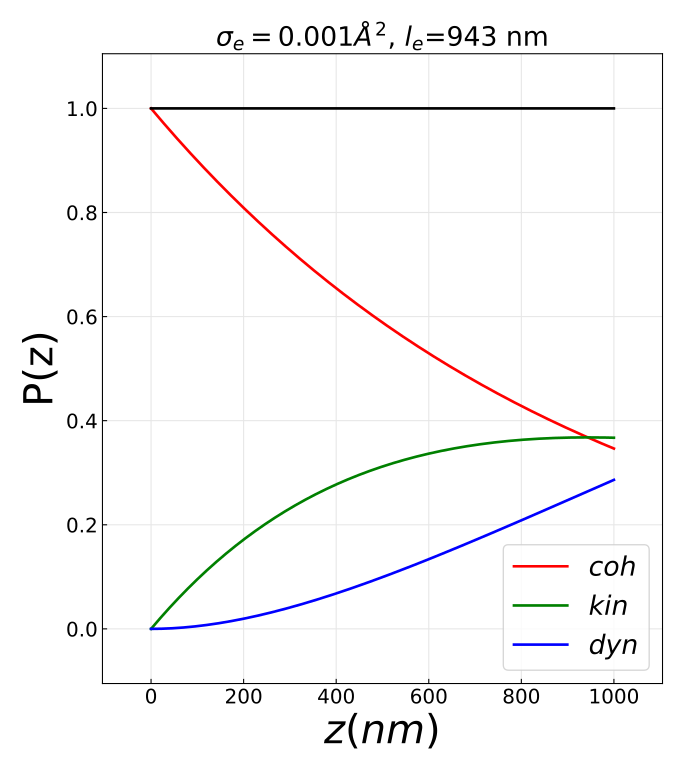
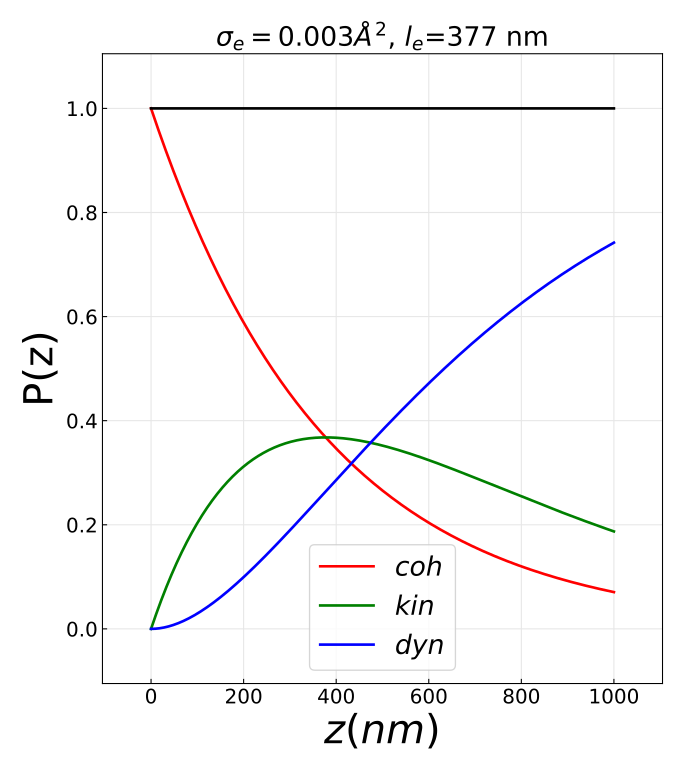
The probabilities of an electron to undergo elastic collisions and inelastic collisions of mean free path after going through a specimen of length follows the Poisson distribution : where
- is the average elastic collision mean free path, being the interaction cross section and the atomic elastic scattering factor.
- is the average inelastic collision mean free path.
- is the number of atoms per volume area.
Latychevskaiaabrahams2019 followed a similar approach where the order of the collisions is considered to determine which sequence of events contribute to Bragg spots. A simplification of her equations considering only 0,1 and more than 1 elastic collisions reads :
which analytical solutions are the Poisson distribution above. The program nearBragg should follow this statistics. Taking for protein atoms per and which covers beam energies and protein average scattering powers give mean free paths ranging .
| small | medium | large |
|---|---|---|
 |
 |
 |