Advanced computing in electron microscopy
Chap5 Thin specimens
Phase grating approximation
- The specimen potential is very small compare to the accelerating potential : where is the wave number of the accelerating potential and the interaction parameter.
- The specimen is thin enough so that the effect of the potential can be summarized as an accumulated projected potential along the beam direction .
weak phase object
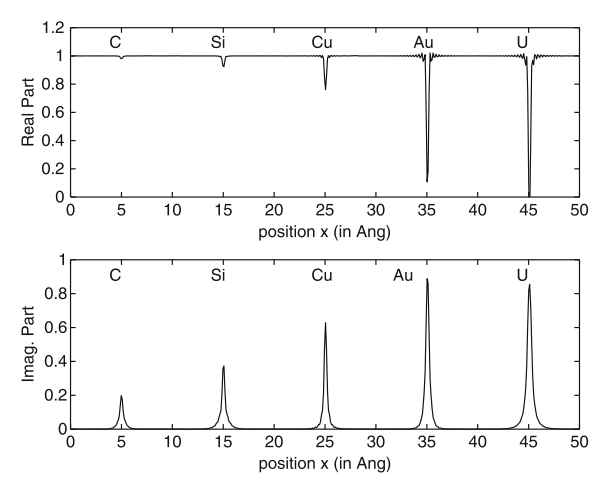
Since the interaction parameter the phase shift due to the projected potential of light atoms is usually quite small for Carbone at . As a result they may be considered as weak phase objects. However the potential exhibits a singularity in real space due to the atomic nucleus so the phase shift may be large if the incident beam passes very close to the nucleus.
| electron density | 3D potential | projected potential |
|---|---|---|
 |
 |
 |
The atomic scattering factor can be calculated within the Born approximation which will be obtained from a simple Fourier transform. The projected potential can therefore conveniently be deduced using the Fourier projection theorem.
However, a proper calculation based on Moliere shows that the atomic scattering factor within the Born approximation makes significant errors in the phase of the scattered electrons especially at large scattering angles where the effect of the nucleus dominates which is actually the region where the neglected effect of bonding is most relevant. Applying the Born approximation for the atomic scattering amplitudes assumes that the atoms are weak phase objects.
| Born approximation for C,Si,Cu,Au,U | Moliere vs Born approximation for Gold |
|---|---|
 |
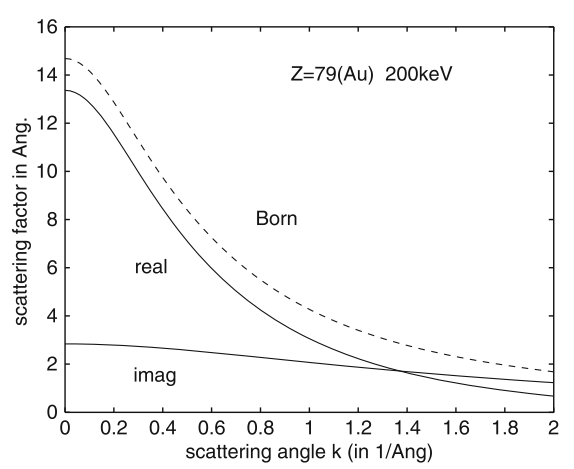 |
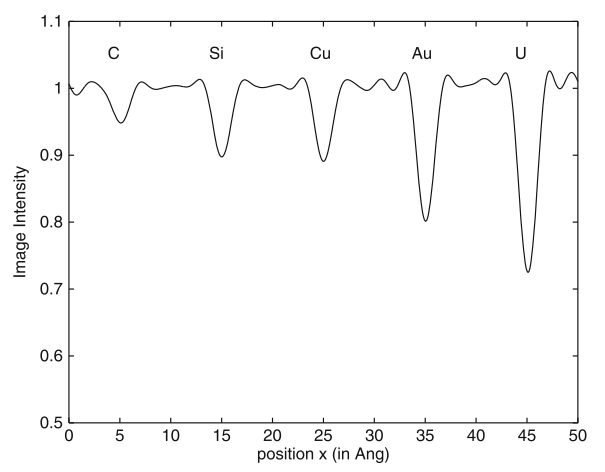
Image of thin specimens
| Projected atomic potentials | Image intensities |
|---|---|
 |
 |
Chap6 Theory
Electron scattering is accounted for by solving Schrodinger's equation :
which is only an approximation of Dirac's equation the electron spin is neglected and relativistic effects not considered (accurate up to electron beam if the energy/wavelength of the electron already takes into account relativistic effects). The magnetic field due to the lenses can be ignored since it affects the electron path over a distance despite being .
ED modelling history
| Date | Name | Advance |
|---|---|---|
| 1928 | Davisson,Bethe | Electron diffraction exp,theory |
| 1957 | Cowley,Moodie | Multislice approach |
| 1959,1962 | Fujimoto,Sturkey | Scattering matrix Bloch |
| 1961 | Howie,Whelan | Dynamical theory non crystal based |
| 1972,1979 | O,Keefe | Multislice:First computer implementation SHRLI |
| 1978 | Glaeser,van Dyck | Path integral formulation |
| 1978,1987 | Cowley,Kirkland | Multi-slice CBED, ADF-STEM |
| 1983 | Kilaas | Real space multislice |
Notes
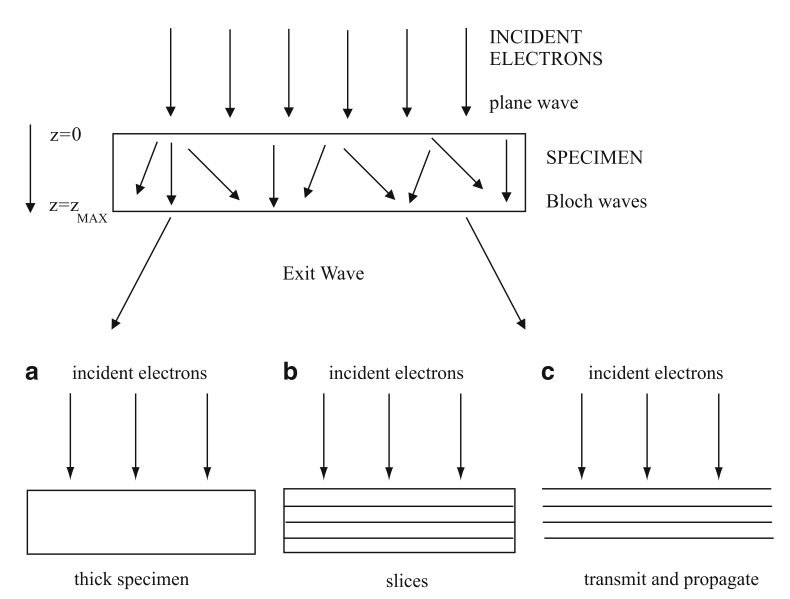
| Prop | Multislice | Bloch |
|---|---|---|
| Number of beams | Fourier components at the FFT stage | Fourier components of the potential |
| Storage scales as | ||
| Computer time as |
| Bloch(up) vs mutlislice(down) | CPU time |
|---|---|
 |
 |
Bloch waves
see Bloch wave.
Fast electron wave equation
Using constant high energy collimated electrons, i.e. and slow varying envelope, i.e. assumptions, Schrodinger's equation reduces to:
where .
Howie Whelan
Assuming period potential and looking for solutions reduces to the system of differential equations :
Multislice
See multislice
Chap7 Applications
see multislice
Chap8 The programs
| atompot+mulslice | autoslic Si[100] |
|---|---|
 |
 |
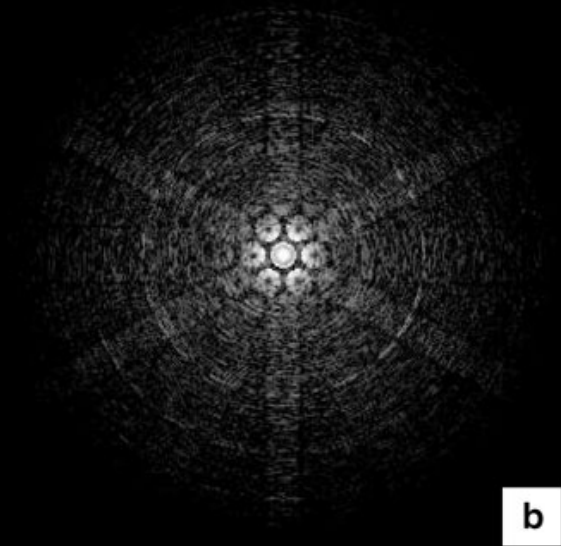
atompot and mulslic
These codes are essentially described in temsim
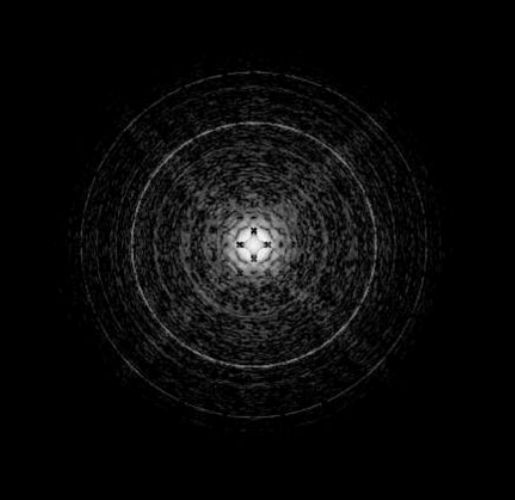
autoslic
Used for non periodic specimen :
- The slices are computed automatically from the input file .xyz.
- The projected potential is directly computed in real space.